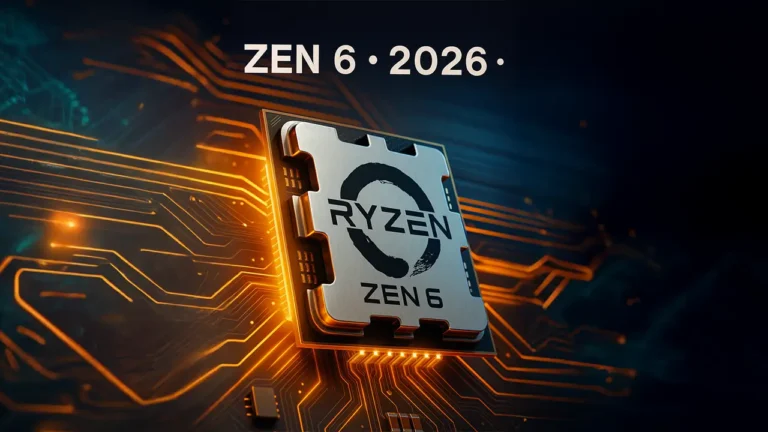
Desktop CPU architecture has hit an inflection point. After years of incremental gains on mature nodes, both Intel and AMD are preparing their most aggressive process leaps in a decade. Intel’s Nova Lake (Core Ultra Series 4) and AMD’s Zen 6 represent the first mainstream consumer architectures targeting TSMC’s and Intel’s respective 2nm-class processes—and the competitive dynamics of 2026 will reshape upgrade cycles for enthusiasts, workstation builders, and gamers alike.
This comparison distills the most credible leaks, foundry roadmaps, and architectural patents circulating in 2024. Nothing here is confirmed silicon, but the convergence of multiple independent sources gives us enough signal to separate probable trajectory from wishful thinking.
Process Node: Intel 14A vs TSMC N2
The node narrative has inverted. For the first time since Sandy Bridge, Intel may fabricate its highest-performance consumer chips on an internal process competitive with—or exceeding—TSMC’s leading edge.
- Intel 14A (1.4nm equivalent): Nova Lake desktop CPUs are widely expected to use Intel’s 14A node, with production ramping at fabs in Arizona and Ireland. Intel claims 14A delivers ~15% performance-per-watt improvement over 18A, with backside power delivery (PowerVia) and gate-all-around (RibbonFET) transistors fully mature. The critical question: yield at high core counts and clock speeds.
- TSMC N2: Zen 6 will likely leverage TSMC’s second-generation 2nm family (N2 or N2P), with AMD potentially accessing the node earlier than Intel’s 14A volume timing. TSMC’s track record for density and power efficiency is proven, though costs per wafer continue climbing—potentially pressuring AMD’s margins or pricing.
The honest read: Intel 14A is the higher-variance bet. If yields materialize as planned, Nova Lake regains process parity. If not, TSMC’s predictability gives Zen 6 a safer floor.
Architecture: What the Patents and Leaks Suggest
Both companies have filed extensively, and kernel/driver leaks have surfaced enough detail to sketch plausible microarchitectures.
Intel Nova Lake: The Big.Little Reckoning
Nova Lake appears to refine—and possibly rethink—the heterogeneous approach Intel committed to with Alder Lake. Leaked topology diagrams suggest:
- A redesigned “Lion Cove” successor (tentatively “Cougar Cove” or similar) for P-cores, with deeper reorder buffers and improved vector throughput
- E-cores that may finally support AVX-512, eliminating the ISA fragmentation that has plagued software optimization
- Modular chiplets or tiles, potentially using Intel’s Foveros Direct 3D stacking for the first time in mainstream desktop
- DDR6 memory support, though timing on DIMM availability remains speculative
The most consequential rumor: Nova Lake may abandon the ring bus entirely for a mesh or fabric topology at higher core counts, addressing the latency penalties that have hampered Core i9 scaling.
AMD Zen 6: Density and Efficiency First
AMD’s roadmap discipline has been its superpower. Zen 6 leaks point to:
- A ground-up core redesign, not merely a Zen 5 refinement—new front-end, expanded execution ports, and native 512-bit vector execution (no more double-pumping)
- Continued chiplet scaling, with compute dies (CCDs) potentially shrinking to 8-10 cores each on N2’s density gains
- Enhanced 3D V-Cache integration, possibly with stacked cache moved closer to the cores or expanded beyond 128MB per CCD
- Unified memory controller improvements for DDR5-8000+ native support, with DDR6 readiness
AMD’s patent filings also hint at speculative execution hardening and security features that may reduce some vulnerability to side-channel attacks—relevant for enterprise and security-conscious builds.
Performance Projections: Where Bets Diverge
Without silicon, all performance claims are modeled. But we can reason from node characteristics and architectural direction:
| Dimension | Intel Nova Lake (Projected) | AMD Zen 6 (Projected) |
|---|---|---|
| Single-thread uplift vs current gen | +20-30% (node + IPC) | +15-25% (IPC-focused) |
| Multi-thread scaling | Strong if mesh topology succeeds | Proven chiplet scaling, likely 32+ cores mainstream |
| Power efficiency | Wildcard—14A efficiency gains vs. clock chasing | Probable leader; N2 + AMD’s power management maturity |
| AI/ML acceleration | Enhanced NPU (possibly 100+ TOPS) | NPUs less emphasized; GPU/chiplet acceleration preferred |
| Platform longevity | New socket (LGA 1954 rumored) | AM5 likely extended, or AM6 transition |
The single-thread race remains Intel’s to lose—its P-core design philosophy prioritizes latency-sensitive performance. AMD’s strength is workload breadth: efficiency, server-derived reliability, and the flexibility of chiplet economics.
The Honest Uncertainties
Any 2026 preview carries material unknowns. Buyers should weigh these specifically:
- Intel’s execution risk: 14A is Intel’s first node on ASML’s High-NA EUV. Delays here cascade directly to Nova Lake availability and pricing. The company’s foundry separation (Intel Foundry as distinct from Intel Products) adds organizational complexity.
- AMD’s pricing pressure: TSMC N2 wafers are substantially costlier than N3E. AMD must either absorb margin, raise prices, or constrain die sizes—any of which affects the value equation.
- Software ecosystem: Intel’s Thread Director and heterogeneous scheduling remain works in progress. Nova Lake’s success depends on Windows and application developers finally optimizing for hybrid architectures.
- Memory transition timing: DDR6 availability in 2026 is plausible but not guaranteed. Early adopters may face DDR5 fallback or premium DDR6 scarcity.
Who Should Wait, Who Should Buy Now
For builders deciding between upgrading in late 2024/2025 or holding for 2026:
Wait for Nova Lake or Zen 6 if:
- You are on Zen 3, Rocket Lake, or older—generational gains will be substantial
- Your workloads benefit from AVX-512, AI acceleration, or memory bandwidth expansion
- You prioritize efficiency and platform longevity for a 5-7 year build
Buy current-gen (Zen 5, Raptor Lake/Arrow Lake) if:
- You need a system before Q2 2026; early availability for both architectures remains uncertain
- Your workload is GPU-bound or satisfied by existing 16-core performance
- You find compelling pricing on AM5 or LGA 1700/1851 platforms with clear upgrade paths
Bottom Line
Nova Lake vs. Zen 6 is not merely a product cycle refresh—it is a test of whether Intel’s foundry bet pays off in consumer silicon, and whether AMD’s chiplet strategy can maintain its momentum against a potentially resurgent competitor. The 2nm transition will deliver genuine performance gains; the open question is which company delivers them with the consistency, pricing, and platform maturity that enthusiasts actually live with.
We will validate these projections as engineering samples surface, BIOS leaks proliferate, and both companies tighten their public roadmaps. Until then, build for your timeline, not the horizon.